
Flight Connectivity and Real Estate in Baja Sur
In real estate, the runway often predicts the rooftop. Few markets prove that better than Baja California Sur, where flight connectivity has become the clearest leading indicator of where property demand — and prices — are heading. Los Cabos International Airport (SJD) closed 2025 with more than 7.5 million passengers, a 173% jump from roughly 2.7 million in 2010, and now offers 61 international destinations with nonstop service, including 32 U.S. cities. The newest addition is telling: on June 4, 2026, Southwest launched its first-ever nonstop from Las Vegas to Los Cabos. At Ronival Real Estate, we've watched two decades of transactions track almost perfectly with the arrivals board. This guide breaks down the verified route data for both BCS airports and what it means for buyers, investors, and owners.
How Does Airport Connectivity Affect Real Estate Values?
Airport connectivity affects real estate values by determining how easily, cheaply, and frequently buyers and renters can reach a destination. More direct routes from more cities mean a larger pool of potential second-home owners and a steadier flow of vacation-rental guests — lifting both purchase demand and rental income, the two forces behind appreciation. A buyer in Las Vegas is far more likely to purchase a Cabo villa now that there's a nonstop flight home rather than a connection and a lost travel day, and a property's nightly rate and occupancy depend heavily on how many travelers can reach it without friction. Connectivity converts a beautiful but remote coastline into an accessible, liquid market — and that accessibility gets capitalized into property prices.
Los Cabos (SJD): The Connectivity Powerhouse
Los Cabos International Airport sits between Cabo San Lucas and San José del Cabo and is the main gateway to the southern tip of the peninsula. Operated by Grupo Aeroportuario del Pacífico (GAP), it now serves 61 international destinations. As of 2025, it is the sixth-busiest airport in Mexico and ranks 23rd in Latin America by passenger traffic.
The Route Network, by the Numbers
SJD's network separates Los Cabos from nearly every other resort market in Mexico: 18 airlines fly in from 53 airports as of June 2026, with roughly 1,909 monthly arrivals — about 448 a week. Mexico City, Los Angeles, and Dallas-Fort Worth are the top routes, and travelers can fly nonstop from 32 U.S. cities spanning California, Texas, the Southwest, the Midwest, and the East Coast — gateways that map directly onto Ronival's buyer base.
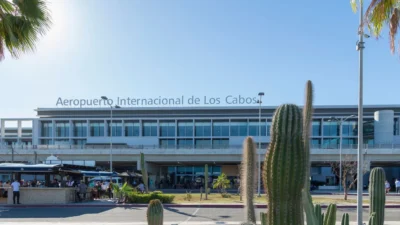
The New Las Vegas Nonstop — and Why It Matters
The headline route of 2026 is Southwest's Las Vegas (LAS) to Los Cabos (SJD) nonstop, which began June 4, 2026, operating daily on Boeing 737 aircraft. It's part of Southwest's first-ever international push from Las Vegas, launched the same day alongside Cancún and Puerto Vallarta, and it's currently the only nonstop between the two cities. The strategic weight is double: Las Vegas is one of America's largest leisure hubs, opening easy long-weekend dual-destination trips, and Harry Reid International is a connecting magnet for Western U.S. cities that still lack their own Cabo nonstop. More seats and a new low-cost competitor also tend to trigger fare deals — and cheaper, easier access widens the buyer and renter pool. For a real estate market, a carrier committing daily capacity is a vote of confidence backed by real money.
More Long-Haul Reach: Panama and Frankfurt
Two other additions reshaped the map. Copa Airlines launched the first-ever direct flight between Panama City's Tocumen International Airport and SJD on December 4, 2025, opening onward connections to more than 85 destinations across Latin America and the Caribbean without a U.S. connection. On the European side, Condor flies nonstop from Frankfurt on a seasonal winter/spring schedule. The real estate signal is the multiplier: international air passengers fuel demand for accommodations, dining, and excursions, sustaining year-round economic activity.
Why Peak-Season Intensity Is the Real Story
Averages understate the demand pulse that drives short-term rental income. A normal day at SJD runs around 60 flights, while a peak-season day can jump to 120 from mid-November through year-end. That doubling is exactly when nightly rental rates and occupancy peak — and why owners of well-located corridor and beachfront properties capture outsized high-season yields.
La Paz (LAP): The Value Market Behind the Connectivity Gap
If Los Cabos is the connectivity powerhouse, La Paz is the value market — and the two facts are directly related. Manuel Márquez de León International Airport (LAP) serves the state capital along the Sea of Cortez, but its route network is a fraction of SJD's.
A Deliberately Small Network
There are 5 airlines flying from La Paz to roughly 20 airports as of June 2026: Aeromexico, Alaska Airlines, TAR Aerolineas, Viva, and Volaris. The airport handles about 378 arrivals each month — roughly 91 per week — and Tijuana, Mexico City, and Guadalajara are its three most popular routes. Critically for U.S. and Canadian buyers, Los Angeles is the only U.S. destination with direct flights from La Paz, operated by Alaska. Tijuana and Mexico City together account for 57% of all monthly arrivals at LAP — meaning La Paz is overwhelmingly a domestic airport, while SJD is built around foreign leisure demand.
What the Gap Means for Buyers
La Paz still moves real volume: the airport ranks among Mexico's top 25 busiest, with more than 1.1 million passengers in 2023. But the thin international network keeps foreign-buyer competition low and prices well below Los Cabos. For a buyer who values authenticity, lower entry points, and is comfortable connecting through LAX — or flying into SJD and driving two hours — La Paz offers a different risk-reward profile: less liquidity and slower rental velocity today, but more runway for appreciation if connectivity expands. There are early signs it might: GAP reported new Viva routes from La Paz in 2025, including La Paz–Santa Lucía and La Paz–Tijuana.
Why Connectivity Is a Real Estate Indicator You Can Trust
Plenty of market signals are noisy. Flight data isn't — airlines don't add routes or aircraft on a hunch, they commit capacity based on hard demand forecasts, making the route map one of the most honest forward indicators a property investor has. The fact that Southwest chose to spend its first international slots from Las Vegas on Cabo is itself a data point. The connection to the BCS buyer pool is documented: in early 2025, international flights made up around 70% of SJD arrivals, led by Los Angeles, Dallas, and Phoenix, with California alone supplying about 37% of U.S. tourism to Los Cabos, followed by Texas and Washington — and from Canada, Vancouver, then Calgary and Toronto. These are precisely the markets Ronival's foreign buyers come from. Hospitality data confirms it: Los Cabos held average occupancy near 70% at an average daily rate around $440 across 2025, hitting 84% occupancy and a $498 ADR at peak in March. High occupancy at premium rates is where vacation-rental owners do best — downstream of the same connectivity that fills the planes.
How Ronival Reads the Runway
Over two decades in this market, Ronival treats the route map as a planning tool, not trivia. When a new gateway city gets nonstop service, we watch for buyer inquiries from that metro the following season — Las Vegas, Panama City, and Frankfurt are the newest test cases, pointing to a buyer pool diversifying beyond the traditional U.S. West Coast base. When peak-day flight counts double, we counsel rental owners on pricing windows, and when a market like La Paz stays thin on international routes, we frame it honestly as a value play with timing risk, not a substitute for Los Cabos liquidity. The infrastructure backs the thesis: SJD is mid-way through a roughly $370 million master plan to add terminal space and gates — capacity built today is demand the industry expects to fill tomorrow.
What This Means for Your Buying Decision
For most foreign buyers, connectivity should shape where in BCS you buy, not just whether you buy. If your priority is rental income and easy resale, properties tied to the SJD catchment — Cabo San Lucas, San José del Cabo, and the Corridor between them — benefit from the deepest, most resilient demand pool in the state, now reinforced by the new Las Vegas link. If your priority is value and lifestyle over liquidity, La Paz and the surrounding Sea of Cortez communities trade at a discount that exists largely because of the connectivity gap — a gap that could narrow. Either way, the route map gives you a forward read price history alone can't. A market adding airlines, destinations, and seats is a market the aviation industry is betting on with real capital. That's the kind of signal worth aligning your own capital with.
Frequently Asked Questions
Is there a direct flight from Las Vegas to Los Cabos?
Yes. Southwest Airlines launched a daily nonstop from Las Vegas (LAS) to Los Cabos (SJD) on June 4, 2026, flown on Boeing 737 aircraft. It is currently the only nonstop between the two cities and part of Southwest's first international expansion from Las Vegas, alongside new Cancún and Puerto Vallarta routes.
How many destinations can you fly to from Los Cabos airport?
As of 2026, Los Cabos International Airport (SJD) offers 61 international destinations with nonstop service, including 32 U.S. cities, served by 18 airlines. You can also fly nonstop from Canada, Mexico, Panama, and seasonally Germany, making SJD the most connected resort airport in the region.
Does La Paz have direct flights from the United States?
Yes, but only one. As of June 2026, Los Angeles is the only U.S. city with a direct flight to La Paz (LAP), operated by Alaska Airlines. Most travelers from other U.S. cities connect through a Mexican hub or fly into Los Cabos (SJD) and drive about two hours north.
Why does flight connectivity matter when buying property in Baja California Sur?
Connectivity drives both buyer demand and rental income. More nonstop routes from more cities enlarge the pool of potential second-home owners and vacation-rental guests, supporting higher occupancy, stronger nightly rates, and more stable appreciation. The route map is one of the few forward-looking indicators of where demand is heading.
The Bottom Line
Flight connectivity is the most reliable leading indicator most BCS buyers never check. The numbers tell a clear two-market story: Los Cabos — 61 international destinations, 18 airlines, 7.5 million passengers, and a brand-new daily Las Vegas nonstop — offers the deepest demand pool and the strongest rental economics in the state, while La Paz, with a single U.S. route and a largely domestic network, trades at a value discount that exists precisely because of that connectivity gap. New routes from Las Vegas, Panama City, and Frankfurt signal a broadening buyer base, and a $370 million airport expansion confirms where the industry expects demand to go. Match your property location to the connectivity profile that fits your goals — income and liquidity, or value and lifestyle — and you'll be buying on data, not hope. Ronival's commercial division is one of the most active in Baja California Sur, with deep relationships across developers, hotel brands, and institutional investors. Browse current opportunities at https://www.findmexicohouses.com/buy/.
© 2026 Ronival Real Estate | FindMexicoHouses.com | All rights reserved.